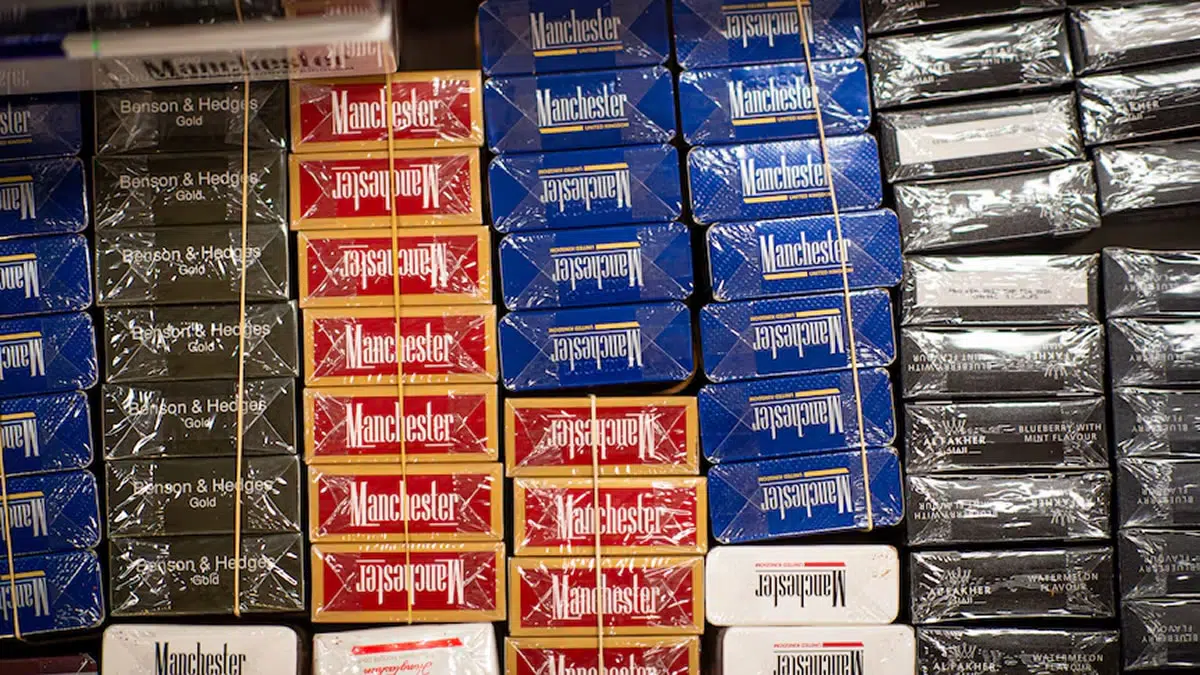
The Australian Government is launching a major crackdown on the multi-billion-dollar illicit tobacco and vape trade, introducing wire taps, expanded surveillance, and triple maximum jail terms. Assistant Minister Julian Hill confirmed that over 50% of tobacco and 95.7% of vapes sold are now illegal, costing the budget up to $11.8 billion in lost excise revenue.
The Surveillance Shift: Wire Taps and Asset Seizures
In a decisive move to treat tobacco smuggling as a “serious crime,” the Commonwealth will arm investigators with powers typically reserved for counter-terrorism and high-level drug trafficking. Under the proposed legislation, the Australian Border Force (ABF) and federal police will gain the authority to use telecommunications interceptions (wire taps) to dismantle organized crime syndicates. These gangs, which Assistant Minister Julian Hill describes as operating like “multinational businesses,” have exploited a perceived high-profit, low-risk environment for over a decade.
A cornerstone of the new strategy is the targeting of “unexplained wealth.” Authorities will now have expanded powers to seize high-value assets—including luxury cars, boats, and real estate—linked to criminal profits. By increasing maximum jail terms by up to three times current limits, the government aims to recalibrate the risk-reward ratio that has made Australia a global target for illicit nicotine products.
Market Saturation: The 2024-25 Commissioner’s Report
The scale of the black market has reached unprecedented levels, effectively normalising law-breaking across the retail landscape. Data from the Illicit Tobacco and E-Cigarette Commissioner reveals a staggering loss of control over the supply chain. Organized crime groups are estimated to have generated between $4.1 billion and $6.9 billion in profit during the last financial year alone. The ubiquity of “cheap smokes” has created a public health crisis that threatens to unwind decades of successful smoking reduction programs.
| Market Segment | Illicit Market Share (%) | Estimated Market Value / Profit |
|---|---|---|
| Traditional Tobacco | >50.0% | $4.1B – $6.9B (Profit) |
| E-Cigarettes (Vapes) | 95.7% | $1.6B (Market Value) |
| Lost Federal Excise | N/A | $7.7B – $11.8B (Revenue Loss) |
The Excise Deadlock: Why Taxes Remain High
Despite acknowledging that high excise rates have been a “key driver” of the black market’s growth, the federal government has explicitly rejected calls to lower tobacco taxes. Assistant Minister Hill argued that no “reasonable level” of excise reduction would currently impact the entrenched illicit supply chains. The government maintains that price remains the most effective lever to discourage smoking, even as critics point to the “market imbalance” created by Australia’s world-leading tobacco prices.
Industry skeptics, including former Border Force officer Rohan Pike, argue that while enforcement is necessary, it cannot be the “one and only” solution. Pike suggests that the massive price gap between legal and illegal products provides an almost irresistible incentive for criminals. He advocates for a harm minimisation approach, similar to the United Kingdom or New Zealand, where newer nicotine products are regulated and legalised as alternatives to combustible cigarettes, rather than being forced into a medicalized “prescription-only” model that has struggled to gain traction.
Post-Border Disruption: Targeting Shopfronts and Landlords
The crackdown is shifting focus from the borders to the “street level.” Julian Hill warned that talking tough about border seizures is meaningless unless illegal shopfronts are shut down. The Commonwealth is urging states and territories to prioritize enforcement against retailers and, crucially, the landlords who lease premises to illicit operators. South Australia and Queensland have been singled out as leaders in this “post-border” disruption, demonstrating that 100% geographic enforcement can rapidly return trade to legitimate retailers.
Furthermore, the government is sounding the alarm on the “disgusting” rapid growth of nicotine pouches. These products, which are currently unregulated and often unlawfully imported, are the next target for legislative reform. As the black market evolves toward online distribution and novel nicotine formats, the government promises a “multipronged” response that includes reforming product regulations to prevent a new generation from falling into nicotine dependency.
Political Friction and the Path Forward
The opposition has been quick to label the Labor government’s response as “all talk and no action.” Shadow Home Affairs Minister Jonno Duniam claims the “soft touch” approach has allowed organized crime to flourish while costing the budget billions. A Senate inquiry is scheduled for next month to examine more effective responses. As firebombings and gang-related violence linked to tobacco turf wars continue, the pressure is on the Albanese government to prove that these expanded surveillance powers will translate into a tangible reduction in black market availability.


