Reusable electronic cigarettes and nicotine e-liquids are legal for adults aged 18 and older in France, but single-use disposable vapes (“puffs”) are banned. Vaping is prohibited in enclosed public transport, schools, and collective indoor workplaces, with upcoming laws set to restrict flavors and nicotine levels by mid-2026.
- Age Requirement: You must be at least 18 years old to purchase any vaping device or e-liquid, regardless of nicotine content.
- Disposable Vape Ban: The sale and distribution of single-use disposable vapes are prohibited nationwide due to environmental and youth health concerns.
- Nicotine Pouch Ban: Starting March 2026, France will enforce a ban on nicotine pouches that extends to personal possession and importation.
- Product Limits: E-liquids containing nicotine are capped at a maximum strength of 20 mg/ml and a bottle volume of 10 ml under European standards.
The French government has tightened regulations on nicotine and vaping products, establishing strict rules for residents and travelers alike. While reusable electronic cigarettes remain legal for adults, recent legislative updates have banned disposable devices and introduced bans on smoking in public outdoor spaces. Understanding these laws is essential for anyone residing in or visiting France.
This guide details the legal status of vaping, product restrictions, public usage rules, travel guidelines, and upcoming legislative changes.
General Legality and Age Restrictions
Vaping is legal in France for adults. The primary legislation governing tobacco and vaping control is codified in the French Public Health Code, which has evolved from the historical Veil Law of 1976 and the Evin Law of 1991. France has been a party to the World Health Organization Framework Convention on Tobacco Control (WHO FCTC) since February 27, 2005.
Under Article L3513-5 and R. 3515-6 of the Public Health Code, the sale of vaping products to minors under the age of 18 is prohibited. This age restriction applies to all vaping hardware and e-liquids, including nicotine-free options. The law requires retailers to verify the age of customers before completing a sale. Retailers who violate this law face fines ranging from €135 to €750.
Vaping products are regulated similarly to tobacco products regarding promotion. Direct and indirect advertising of vaping devices and e-liquids is illegal under Article L3513-4 of the Public Health Code. Specialized vape shops may display signage inside their premises, but this material must not be visible from the street. Sponsorship and patronage that promote vaping brands are also prohibited.
The European Tobacco Products Directive (TPD) in France
France transposed the European Union Tobacco Products Directive (Directive 2014/40/EU) into national law on May 19, 2016, through Ordinance No. 2016-623. This directive establishes strict standards for product safety, packaging, and chemical limits.
For e-liquids containing nicotine, the TPD enforces the following rules:
- Maximum Bottle Size: Nicotine-containing e-liquids can only be sold in bottles with a maximum volume of 10 ml.
- Nicotine Cap: The maximum allowable nicotine concentration is 20 mg/ml.
- Tank Capacity: Pre-filled cartridges and disposable reservoirs must not exceed a capacity of 2 ml.
- Safety Features: All refill bottles must feature child-resistant caps, tamper-evident seals, and leak-free filling mechanisms.
- Ingredient Restrictions: E-liquids must not contain vitamins, colorings, or additives that facilitate nicotine uptake or create an impression of health benefits. The use of the word “Tobacco” in product names is replaced by the term “Classic.”
Before placing any nicotine-containing e-liquid on the market, manufacturers and importers must submit a detailed notification file to the French Agency for Food, Environmental and Occupational Health & Safety (ANSES) six months prior to sale. This file must include toxicological data on ingredients and emissions.
The Ban on Disposable Vapes (“Puffs”)
France has banned the sale and distribution of single-use disposable vapes, commonly referred to as “puffs.” The law targets electronic vaping devices that are pre-filled with liquid and cannot be refilled, regardless of whether the battery is rechargeable. It does not prohibit reusable systems that use replaceable pre-filled pods or cartridges.
The ban was driven by environmental concerns regarding the disposal of lithium-ion batteries and plastic casings, alongside public health efforts to prevent nicotine addiction among school-aged children. France follows Belgium as the second EU country to implement a national ban on these devices, setting a precedent that may influence future updates to the EU-wide Tobacco Products Directive.

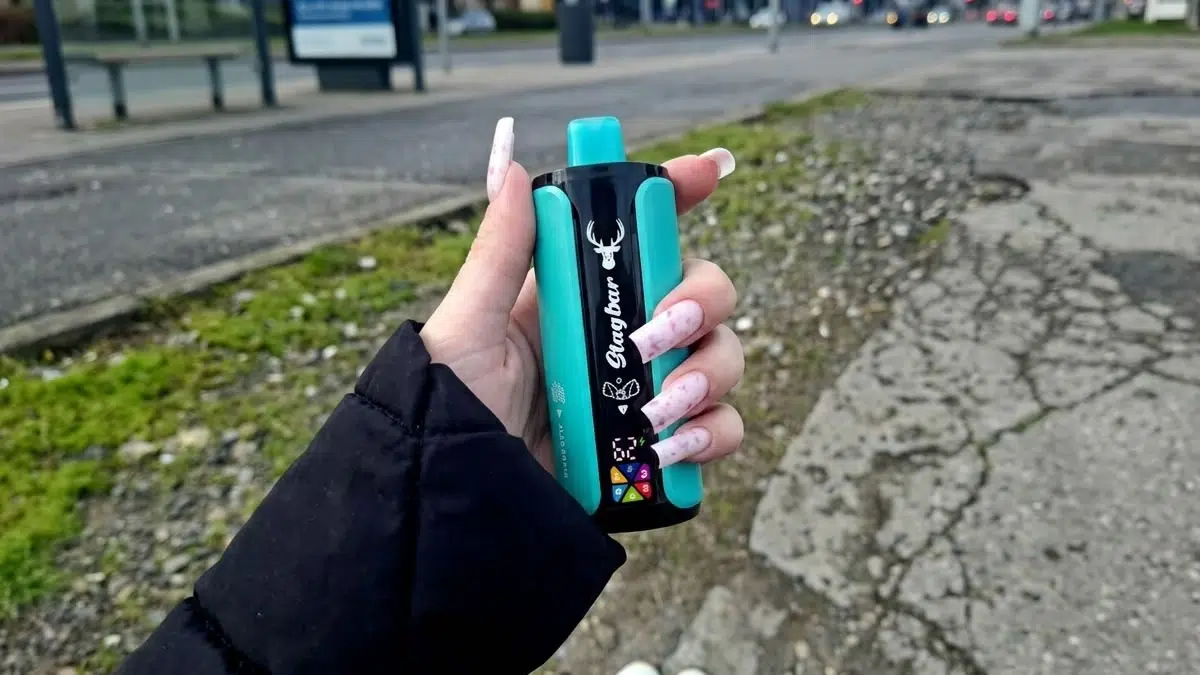
StagBar Vape 4in1 80K Puffs Disposable
The Stagbar 4-in-1 80,000 is a revolutionary high-capacity disposable featuring 4 flavors and 4 independent mesh coils in one device, delivering an industry-leading 80,000 puffs.
Where Vaping is Prohibited and Allowed
Vaping in public spaces in France is governed by separate rules for indoor and outdoor environments. The regulations differ slightly from those applied to traditional combustible cigarettes.
Indoor Public Places and Workplaces
Under Article L3512-6 of the Public Health Code, vaping is prohibited in the following indoor locations:
- Educational institutions (schools, colleges, universities) and facilities dedicated to the training or accommodation of minors.
- Enclosed collective transport vehicles, including buses, trains, subways, and domestic flights.
- Enclosed and covered collective workplaces, such as open-plan offices, meeting rooms, workshops, canteens, and rest areas.
Individual offices that can be closed by a door are not legally covered by the national ban, though internal company policies can still prohibit vaping there. Employers must display clear signage indicating the vaping prohibition. Failure to display this signage can result in a €450 fine for the employer, while individuals caught vaping in prohibited workplaces face fines between €35 and €150.
Enclosed public spaces that are not designated as collective workplaces—such as bars, restaurants, cafes, hotels, and shopping centers—are not subject to the national statutory ban. In these venues, the decision to allow or prohibit vaping rests with the owner or manager. Visitors must comply with the internal regulations of the establishment.
Outdoor Public Spaces
In mid-2025, France implemented a decree banning traditional smoking in specific outdoor areas frequented by children, including public parks, beaches, forests, and zones near schools. Violating these “tobacco-free spaces” (espaces sans tabac) carries a €135 fine.
However, e-cigarettes were excluded from this specific national outdoor ban. Legally, vaping remains permitted on outdoor café terraces, beaches, and in public parks, unless local municipal bylaws or specific venue rules state otherwise. During periods of high wildfire risk, local authorities frequently issue temporary bans on both smoking and vaping in forested areas.
Traveling to France: Airport, Flight, and Train Rules
Travelers entering France must adhere to strict safety and customs regulations regarding vaping equipment and e-liquids. The rules differ depending on whether you travel by air or by train.
| Transport Mode | Device & Battery Rules | E-Liquid Limits | On-Board Usage Status |
|---|---|---|---|
| Air Travel | Must be kept in carry-on baggage. Forbidden in checked luggage due to fire risks. | Max 100ml per bottle in carry-on (must fit in a 1L clear bag). No limit in checked bags. | Strictly prohibited. Charging devices is also forbidden. |
| Eurostar Train | Must be kept in carry-on baggage or personal bags. | No strict liquid volume limits for luggage. | Strictly prohibited on board, in terminals, and on platforms. |
Due to cabin pressure changes during flights, vape tanks are prone to leaking. Travelers should empty their clearomizers before boarding. Vaping and charging devices are prohibited on all flights and inside Eurostar train compartments.
The Nicotine Pouch Ban (Effective March 2026)
France has enacted a ban on nicotine pouches and other non-tobacco oral nicotine products, effective March 2026. Unlike typical tobacco control laws, this decree prohibits not only the manufacture, import, and sale of these products but also personal possession and use. Travelers entering France after March 2026 are legally prohibited from carrying nicotine pouches (such as ZYN) into the country. Traditional tobacco, vapes, and approved medical nicotine replacement therapies (NRTs) remain exempt from this specific ban.
Legal Status of CBD and THC Vaping
Cannabidiol (CBD) and Tetrahydrocannabinol (THC) are subject to different legal frameworks in France due to their molecular structures and effects on the body.
- THC Vaping: THC is classified as a psychoactive, addictive drug and is illegal. Vaping THC-infused liquids or using cannabis vape pens carries spot fines starting at €200, which are recorded on a criminal record.
- CBD Vaping: Vaping CBD e-liquids is legal under strict conditions. The hemp plant used for extraction must contain less than 0.2% THC, and the final e-liquid must contain 0% THC. Under the French Public Health Code, only the seeds and fibers of the hemp plant may be used for extraction; the use of hemp flowers is prohibited.
CBD is not classified as a medical treatment. Manufacturers are legally barred from making therapeutic claims about CBD products unless they have received formal approval from health authorities.

StagBar Vape 6in1 180K Puffs Disposable
The Stagbar 6-in-1 featuring a unique 6-flavor system and six independent mesh coils, this device allows users to switch between six distinct tastes in one sleek unit, delivering an unprecedented 180,000 puffs.
Future Outlook: 2026 Restrictions on Flavors and Nicotine
France plans to introduce further restrictions on vaping products by mid-2026 as part of its 2023–2027 National Tobacco Control Plan. The government aims to reduce smoking-related deaths, which account for approximately 75,000 fatalities annually in the country.
Health Minister Catherine Vautrin stated: “I would like us to reduce the permitted nicotine levels and the number of flavors available. We hope to make those decisions during the first half of 2026, in consultation with scientific and technical experts.”
The proposed measures aim to curb youth vaping rates by limiting sweet and fruity flavors that critics argue target adolescents. The exact limits on nicotine caps and permitted flavor profiles will be finalized following consultations with public health agencies.
FAQs
-
Can I buy disposable vapes in France?
No. Single-use disposable vapes (“puffs”) are banned from sale and distribution throughout France. You can only purchase reusable, refillable e-cigarettes and compliant e-liquids.
-
Is it legal to vape on a café terrace in France?
Yes. While France’s outdoor smoking ban covers parks, beaches, and school zones, e-cigarettes are excluded from this national restriction. Vaping on outdoor terraces is legal unless the establishment’s private house rules prohibit it.
-
Can I bring ZYN or other nicotine pouches into France?
No. Starting March 2026, France’s ban on nicotine pouches prohibits import, sale, and personal possession. Carrying these products into the country is illegal.
-
What is the maximum nicotine strength available in France?
Under TPD regulations, the maximum nicotine strength allowed for e-liquids is 20 mg/ml, and the maximum bottle size containing nicotine is 10 ml.
-
Can I vape CBD legally in France?
Yes, vaping CBD is legal provided the e-liquid contains 0% THC and is manufactured using fibers and seeds from approved hemp varieties containing less than 0.2% THC.
Disclaimer: The information provided in this article is for informational purposes only and does not constitute legal advice. Vaping regulations and customs laws are subject to change. Travelers and residents should consult official French government sources, such as the French Ministry of Health or Legifrance, for the most current legal directives.


